Copyright:ICFC Official Account
Recently, the research paper, "Power-Efficient Neural Network with Artificial Dendrites, " was published online by Nature Nanotechnology by a team of researchers from Tsinghua University's Institute of Microelectronics, Professor Qian He, and Professor Wu Huaqiang of the Future Center for advanced innovation in chip technology in Beijing, a novel artificial neural network including Synapses, dendrites and cell bodies is constructed by introducing an artificial dendrite computing unit with rich dynamic characteristics, which improves the accuracy of the network calculation and significantly reduces the power consumption of the system.
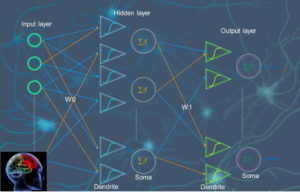
Sketch map of a new artificial neural network including dendrite computation
Dendrites in biological neurons have very complex topological structures and dynamic processes, especially in the human brain. Many pieces of research on the biological nervous system show that dendrites have a very important function of nonlinear spatiotemporal information processing, which is one of the important reasons why the brain can process complex tasks with low power consumption. Most current artificial neural networks simplify neurons into simple point models, simplify their computing functions into integral-and-fire, and neglect the information processing function of dendrites. Such simplification still leaves a big gap between artificial neural networks and biological neural networks in terms of the flexibility, robustness, and power consumption of complex task processing.
Inspired by the electrochemical dynamics of biological nervous systems, the team developed a new principle-based device that simulates dendrite function by selecting material systems and designing device structures, the method of nonlinear filtering, integration, and processing of time signal by biological dendrites is successfully reproduced. To verify the computational power of the artificial dendrites, the team also integrated the artificial dendrites with a synapse based on conducting filaments and a cell body based on Mott's phase transition, a novel artificial neural network is constructed, which consists of three important computing units: Synapse, Dendrite, and cell body. The experimental results show that the dynamic power consumption of the cell body is reduced 30 times and the accuracy of the network is increased by more than 8% when the SVHN data sets with complex background noise are processed by the network with the introduction of dendrite function, the overall power consumption is estimated to be 3 orders of magnitude lower than the CPU. In the future, through the collaborative innovation and optimization of devices, algorithms, circuits, and architectures, it is expected to further improve the ability of artificial neural networks to deal with complex space-time tasks and build more intelligent low-power neural networks.
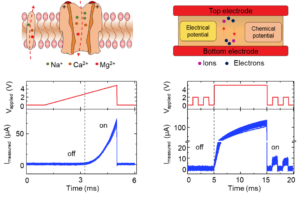
The new principle dendrite device, which is made by biology inspiration, reproduces the function of nonlinear filtering and integral of biology dendrite
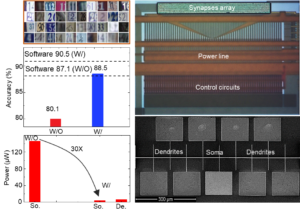
A novel artificial neural network, which integrates three computing units of Synapse, dendrite and cell body, has been proved to be superior in power consumption and accuracy in SVHN data set
Professor Qian He and Professor Wu Huaqiang have been working for a long time on the research of memristor-based integrated memory chip technology. They have achieved innovative breakthroughs in the aspects of device performance optimization, process integration, circuit design, architecture, and Algorithms, etc. , he has published many papers in the top journals of Nature, Nature Electronics, Nature Communications, and Advanced Materials, as well as the international conference on Electronic Devices (IEDM) and international conference on solid-state semiconductor circuits (ISSCC).
Professor Wu Huaqiang of the Institute of Microelectronics of Tsinghua University is the corresponding author of this paper. Dr. Li Xinyi, Assistant Professor Tang Jianshi, and Dr. Zhang Qingtian of the Institute of Microelectronics of Tsinghua University are the co-first authors. The study was conducted in collaboration with Song Sen, a research fellow at the School of Medicine and brain and intelligence laboratory at Tsinghua University, Professor Yang Jianhua of the University of Massachusetts, Professor Xie Yuan of the Alibaba Dharma Institute, and Dr. Lei Deng of the University of California, Santa Barbara. Researchers from Tsinghua University are supported by the National Natural Science Foundation of China, the Key R&D Program of the Ministry of Science and Technology, the Beijing Municipal Science and Technology Commission, and the Beijing National Research Center for Information Science and Technology.
Article Link: https://www.nature.com/articles/s41565-020-0722-5


